I’m still a big fan of Phantom of the Opera, that hasn’t changed. What has changed is it’s been at least twelve years since I wrote the other posts on this site. I have several hobbies, including Phantom, that I sort of rotate between. Therefore, I’m not always focusing on Phantom, rather returning to it from time to time.
I’ve once again returned in July 2025. Looking over my old posts, I don’t disagree with any of them. However, I’ve since read at least one other translation, and some additional analysis that wasn’t available back in 2013.
Translations in 2025
A couple of weeks ago, I was searching on Amazon to see if there was a new translation. I didn’t expect to find one, and I didn’t. However, I did find a book that said it was annotated and illustrated. I’ve always been on the lookout for art depicting the Phantom, so this intrigued me. I downloaded it and started flipping through it. Gaston Leroux’s Gothic Novel, The Phantom of the Opera, Annotated and Illustrated, edited by M. Grant Keller-Myer, M.A. (Referred to as KM from here on.)
The illustrations are white line drawings on a black canvas/background. I appreciate them, and like some more than others, but taste in art is subjective, so others may disagree.
But I also discovered this was a gem hiding in plain sight. The annotations were extensive and well worth reading. In addition, it was a mostly unabridged edition. The editor (also illustrator and the one providing the annotations) reproduced the TdM translation, but then added back in parts that were removed. These sections were freshly translated by the editor. I say mostly unabridged, because there are paragraphs here and there that he skipped. In the introduction where he discusses the translation, he does say he didn’t translate everything, but put back in those passages that flesh out the story. Fair enough.
So, I’m adding this to my own personal list of translations, bringing the total to 7.
As I was reading the translations and annotations of KM, I again got to the part of the book that personally annoys me – that section where Leroux details the managers attempt to determine what happened to their money. Mostly the chapter of the safety pin. I’ve often wished someone would work over the text and pull out this sub-plot so I can focus on the main plot with Erik, Christine, and Raoul.
Which gave me the idea – why don’t I do so? And at the same time, I should do my own translation of what I keep. My French is pretty bad, but with the help of online translators/dictionaries I could do it.
So, I’m seriously thinking of doing this. It will be a multi stage process of course. First, I will go through the English translations and decide what I want to keep and what I want to omit. I already know I’ll summarize the parts I’m throwing out. Something like,
And while these extraordinary events were happening on stage, and setting the audience in an uproar, the managers were locked in their office. They were solely focused on getting to the bottom of Erik’s theft of their money, to the extent that they were in their own world. The acting manager and the secretary noted very strange behavior from them earlier in the evening. And when they attempted to inform the managers of what had occurred, the managers were so caught up in their worry about the money, they didn’t want to hear about anything else.
As the acting manager and the secretary were standing on the stage, not sure what to do, Raoul came up to them and asked where Christine was.
Oof. That’s the silliness summed up. I personally don’t think that whole business really adds anything to the central story. Perhaps I will reword that to emphasize how deeply Erik had affected the managers, but we don’t need all that backing up, not being touched, safety pin nonsense.
As I detailed in Is The Persian A Reliable Narrator?, I don’t think his recounting of interactions between him and Erik are accurate. I’ll omit these too. I’ll start with when he meets up with Raoul.
I’ll also omit the prologue. I know it’s fiction and I don’t need the whole supposed background to the story trying to tell me it’s true. I want to get to the story.
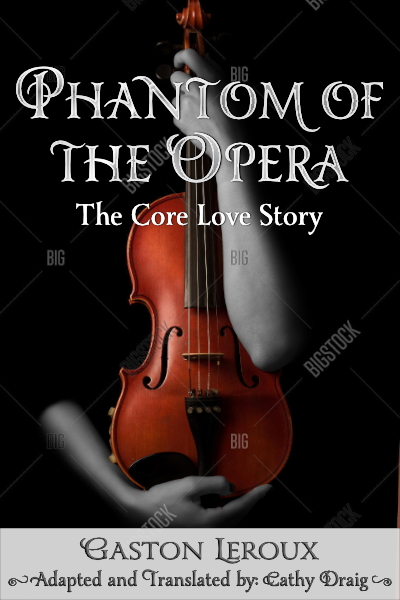
I think I’ll call this: Phantom of the Opera, The Core Love Story
Presuming I do undertake this project, I’ll publish it. I don’t expect many would be interested, but I’ll set it for free. Perhaps I’ll put it in Kindle Unlimited. But, that’s getting way ahead of myself. But, just for funsies, I’m going to look for a picture for the cover. This is what I mocked up (the final will have the fully licensed image, I just used the preview for now.)
Others Thoughts on Translations
I went looking for information on the available translations and I came across commentary, including from some who are bilingual and were approaching their commentary from that perspective. I came away thinking that my effort to adapt Phantom of the Opera for myself would be viewed as inaccurate and be accompanied by an eyeroll or a sneer (or perhaps both) – at least from those folks.
All I can do is shake my head at that. Especially when I read one comment that said MR had grammar errors and stated her translation of “further” vs “farther” is wrong. This commenter explained that “in English” one is for distance, the other is for degree, and therefore the translation was incorrect.
As soon as I read that, I said to myself, “In American English, yes.” I then confirmed with Google that in the UK, “further” is used for both distance and degree. They are only different in American English. There are numerous words in the MR translation that are British spellings, which strongly indicates that MR is not from the US and her English is British English and not American English. (A perfect example of what many deride – rightly – as an American-centric view of the world. As if the way America and Americans do things is the “right” way and other countries are “wrong.”)
Another critique that this commenter had of the MR translation is that she “paraphrases” Leroux and changes the text in a way that detracts from Leroux’s voice. In her introduction, MR points out that she deliberately chose to translate the text in a way that would aid in the words flowing instead of tripping up the reader. Meaning, she acknowledged that her translation wouldn’t always be a word for word literal translation, but may be tweaked to make it flow better. Like with KM above, my opinion in that case is, “I’m okay with that. Because I’m not a snob. I understand that the French of the early 1900s isn’t easily translatable to 2000s English (American or British). The intent of the words is fully preserved.”
Nerdy Translation Discussion Incoming
For instance, the first sentence of the first chapter literally means:
That evening, who was the one where Messrs. Debienne and Poligny, directors resigning of the opera, gave their last evening of gala, on the occasion of their departure, the dressing room of Sorelli, one of the first subjects of the dance, was suddenly invaded by a half-dozen of these young ladies of the corps of ballet who went back scene after have “dance” Polyeucte.
My French isn’t that great, so I’m sure I made some mistakes due to it being past tense, not present. And I probably missed some connecting words that taken together mean something that word-for-word doesn’t mean. But that was my literal, word-for-word translation of the sentence.
In French, adjectives come after the noun. So while we would say “resigning directors,” the French would say “directors resigning.” Therefore, a translation should incorporate that.
Sorelli is described as “one of first subjects of the dance” which is very odd wording in English. If we take “subject” as a person, instead of a topic, then we have “one of the first persons of the dance.” Better, but still not good. Oddly, the word for “female dancer” in French is “danseuse” not “sujets de la danse.” I suspect this difference is due to the time period or a phrase used in French to distinguish lead dancers from the general, or background dancers (the dancer chorus, if you will). So, in the end, I would agree with LB and MR that the term “premiers sujets de la danse” means “leading ballerinas.” As opposed to the young ladies of the ballet corp who would be the general/background dancers.
Speaking of the “young ladies of the corps of ballet who went back scene,” I at first thought this literally meant “backstage.” Except the French is “remontaient de scène,” or verb (remontaient), noun (de scène). Meaning “went back” is the past tense of the verb. So, yeah, as I said, my French isn’t that great.
Literal meaning is way clumsy. As close as possible, I would translate this as: “the young ladies of the ballet corp who left the stage after they “danced” Polyeucte.” Incidentally, I love how Leroux put dancing in quotes, giving the idea that what they did wasn’t particularly polished and probably clumsy. Although, they are young ladies. The French is “demoiselles,” while the term for an unmarried woman (remember this was the early 1900s) was “mademoiselle.” So, in this case, by “young ladies,” Leroux was referring to them being older children, or young teens.
So, my translation of this sentence is:
That evening, the one where Messrs. Debienne and Poligny, the resigning directors of the opera, gave their last gala, celebrating their departure, the dressing room of Sorelli, one of the leading ballerinas, was suddenly invaded by a half-dozen of the young ladies of the ballet corps who left the stage after they “danced” Polyeucte.
And, yes, that is one sentence in the original French. I’ve written many a rambling sentence in my stories, but I then break them up when going back through the text. Which makes me wonder if this is a more modern convention? <shrug> I’ll keep the flavor of the original as much as possible.